
Shrayan Sen
The winter evening was descending slowly over the city. The usual traffic noise, the hurried footsteps, the impatience of urban life—all of it seemed to fade as I stepped into the auditorium of Rabindra Sadan. That evening, the venue was not merely hosting a cultural programme; it had transformed into a space of collective memory and shared inheritance. It was the 13th annual festival of the Sahajiya Foundation, organised with support from the Ministry of Culture, Government of India. What unfolded over the next few hours felt less like a sequence of performances and more like a journey—through faith, folk traditions, poetry, and the living soul of Bengal.
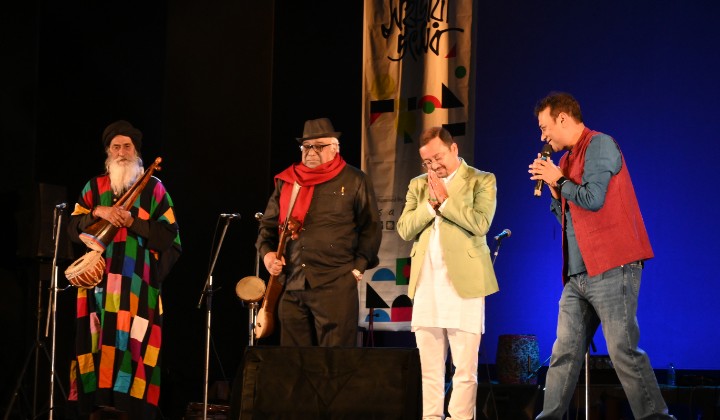
The programme opened with the powerful voice of Mansur Fakir singing, “Nitai Gour Premanande, ekbar Hari bolo.” The hall fell silent almost instantly. There was something deeply moving about hearing a Muslim fakir invoke Nitai and Gour with such devotion. It was a reminder of Bengal’s long tradition of spiritual coexistence, where faith does not divide but connects. In that moment, the song felt larger than music—it became a statement.

Mansur Fakir
That spirit was articulated in words soon after, when veteran artist Shubhendu Maity spoke from the stage. Without hesitation or rhetoric, he said that Bengal had not been divided in the last eight hundred years on religious lines and would not be divided in the next eight hundred either. The response from the audience was immediate and overwhelming. Applause filled the hall, not merely as appreciation, but as agreement. It was one of those rare moments when a cultural gathering openly echoed a social truth.
The evening was anchored by Piyali Pathak, whose calm and composed presence held the programme together. Her voice neither rushed nor intruded; instead, it guided the audience gently from one segment to the next. Early in the programme, homage was paid to srikhol maestro Tilak Maharaj and poet Arun Chakraborty. Though no longer physically present, their influence felt unmistakable—woven into the rhythms and words that followed.
Sidhu’s song then took the audience inward, into a private, introspective space. “Kichudin mone mone ghorer kone, shyamer pirit rakh gopone” he sang, and the line resonated deeply. It was followed by Rina Das Baul’s evocative call to Krishna—an invitation to travel into the garden of devotion. By this point, it felt as though the audience was no longer seated in rows of chairs. Everyone seemed to be walking an inner path, quietly and collectively.
The emotional arc of the evening continued to build. Ritika Sahani and Pilu presented a duet filled with tenderness and quiet longing, while Shubhendu Maity’s songs explored the age-old tension between home and the outside world. Jayati Chakraborty’s renditions of “Arshinagar” and “Majhe Majhe Tobo Dekha Pai, Chirodin Keno Pai Na” stood out as defining moments. The question embedded in those lyrics—of fleeting glimpses and permanent absence—seemed to hover over the entire programme, tying individual performances together into a larger meditation.
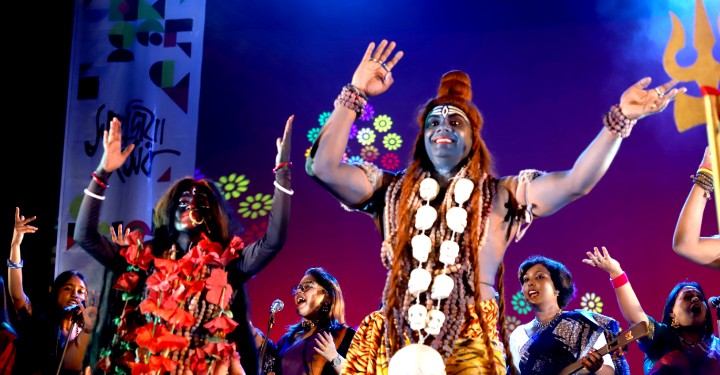
Aghori Dance
Urban life made a brief but meaningful appearance through Nagar Baul Gabu’s songs, where city anxieties merged seamlessly with rural fakir philosophy. Lines like “kokhon tomar ashbe teliphone?” drew gentle laughter but also recognition. Gautam Das Baul and Deb Chowdhury, the soul of Sahajiya, followed with songs steeped in yearning, carrying the audience into quieter emotional waters.
A significant segment of the evening was devoted to honouring individuals who have contributed immensely to Bengal’s cultural landscape. Ranjan Prasad, Mansur Fakir, and filmmaker Abhijit Sen were felicitated by the Sahajiya Foundation. Speaking about Abhijit Sen, Mansur Fakir sang “Na Chahile Jare Pawa Jay,” a song that seemed to capture the essence of effortless grace and destiny. Ranjan Prasad, an alumnus of Ballygunge Government School, shared his journey from grassroots beginnings to wider recognition—a story that resonated with many in the hall.
In tribute to Ranjan Prasad, members of Sahaj Gaaner Pathshala performed “Pather Prante Kono Sudur Ganye,” the Bengali adaptation of Harry Belafonte’s “Jamaican Farewell.” The song, long absorbed into Bengal’s musical imagination, felt both familiar and newly alive. As lyrics about roads, fairs, and distant villages filled the auditorium, it felt as though the audience, too, had joined that journey.
Energy surged again with lively folk numbers from North Bengal, including “Jwalaiya Gela Moner Agun.” Sitting still became difficult. The tempo shifted dramatically when an Aghori dance troupe from Kandi in Murshidabad took the stage during “Bhabomoyeer Rup Dekhiya.” Rooted in an ancient Shaivite tradition distinct to Bengal, the performance revealed a lesser-seen facet of the region’s spiritual practices. It served as a reminder that Bengal’s cultural identity is layered, complex, and deeply rooted in local histories.
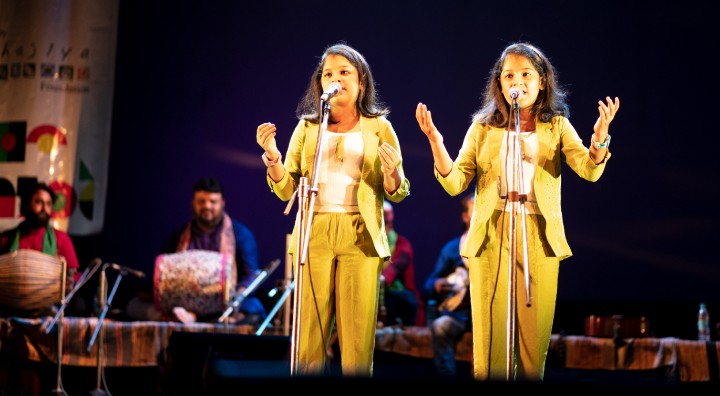
Tani Muni
The programme then turned contemplative once more. Shobhanasundar Bose recited poetry by Birendra Chattopadhyay, focusing on the lives of Adivasi and hill communities. The hall grew still, listening. Tani Muni’s duet evoked the call of the flute beneath the kadamba tree, while Arkadeep’s Lalon songs reaffirmed the timeless relevance of Baul philosophy. Swapan Bose—often called the “jeans-clad Baul”—brought fakiri songs from Sylhet, blending tradition with a contemporary sensibility. Child artist Ritisrota followed with a haunting question: “amar hat bandhibi, paa bandhibi, mon bandhibi kemone?” It was a reminder that folk traditions are not relics—they are being carried forward by younger voices.
One of the most striking moments came through poetry rather than song. Mounita Mukherjee Chattopadhyay, anchor of Good Morning Akash on Akash 8, presented a poetic reading where silence spoke louder than words. Her delivery made it clear that poetry often begins where language ends, in the spaces between sounds.
As the evening neared its conclusion, the microphone was taken by Deb Chowdhury. For me, this moment was deeply personal. My father had first met him in 1997 while returning from the Book Fair, and from that chance encounter grew a lasting bond. As a child, I could not fully understand who he was. Over the years, as I grew older, his commitment to folk research, documentation, and the welfare of folk artists became increasingly clear to me. There are many folk singers, but very few who dedicate their lives to preserving traditions and supporting the communities behind them. That evening, Debda sang Shah Abdul Karim’s “Kemone Chinibo Tomare,” a song that asks how one recognises the beloved.
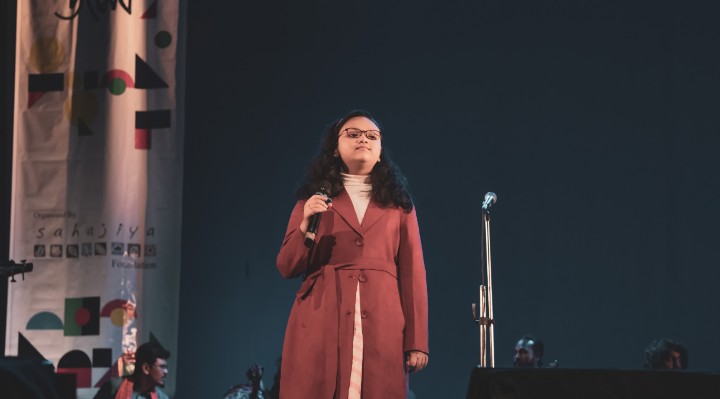
Hridisrota
The festival came full circle with Mansur Fakir returning to the stage. His powerful rendition of “Joy Radhe Joy Radhe,” accompanied by harir-loot and madhukari, lifted the entire hall into collective celebration. The night had grown deep by then.
When the programme finally ended, people rose slowly from their seats and made their way home. Yet the Sahajiya spirit lingered. It walked alongside them—echoing in ears, settling in minds, and finding a quiet place in the corners of the heart, where love, memory, and music continue to reside long after the final note fades.