
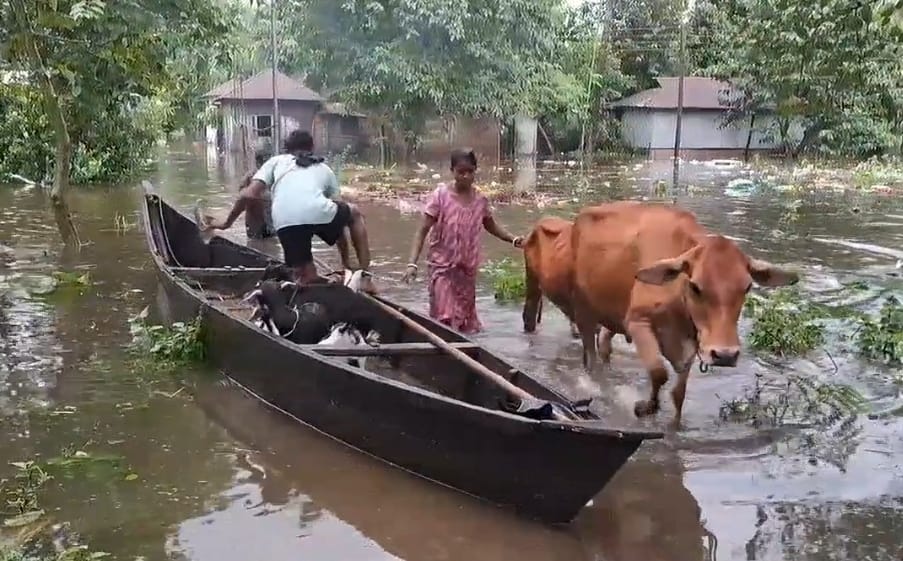
After a night of relentless extremely heavy rainfall, floodwaters have begun to recede across several parts of North Bengal, bringing partial relief to the region battered by torrential downpours and overflowing rivers. In Jalpaiguri and adjoining districts, the situation has started improving as the water levels of major rivers — Teesta, Jaldhaka, and Murti — have begun to fall. The retreating waters have exposed stretches of damaged roads, submerged croplands, and scattered debris across several flood-hit villages.
In areas like Mainaguri, Dhupguri, villagers have started returning home after spending nights in temporary relief camps. Mud-filled courtyards, uprooted fences, and collapsed thatched roofs marked the landscape as residents began cleaning their homes and salvaging what remained of their belongings.
Train services, which had been disrupted due to track inundation near Mainaguri, are limping back to normal after emergency repairs were completed late Sunday night. Road connectivity between Malbazar and Dhupguri is also improving, with local authorities using pumps to clear waterlogged intersections.
While the immediate threat to life has eased, the floods left a significant impact on Gorumara National Park and its surrounding forest belts. The park, known for its rhinos, bisons, and deer population, witnessed extensive flooding that pushed several wild animals into nearby tea gardens and human settlements.
Wildlife rescuers and the Forest Department have been working tirelessly to rescue and guide the animals back into the forest. Parthasarathi Roy, Wildlife Rescuer and Mountaineering Instructor, said, “The biggest challenge now is to drive the bisons back to the forest from human settlements. After an all-night effort, we, along with PPS (Poribesh Premi Songothon) and the Forest Department, managed to rescue the rhino that had fallen into a pit twice. The deer was rescued by evening. At present, one bison is moving from the Bideshipara area towards Dhupguri.” He further added, “The PPS team has worked tirelessly here, putting in their heart and soul. Yes, one rhino, a baby bison, and a deer carcass have been recovered. There’s still no clear count of how many animals have been swept away.”
Parthasarathi also acknowledged the role of an early weather warning that helped minimize damage and save lives. He expressed his gratitude to a Kolkata-based private weather observer who had warned about the impending disaster nearly 24 hours in advance.
“Because of the early alert, we were prepared from last night itself, anticipating that problems might arise. That’s why we could begin rescue operations right from the moment the embankment started to break — many lives were saved. As soon as we received the update, our rescue team was informed and put on high alert. All equipment was kept ready, and when the report came in around 7 a.m., it helped us immensely to act without delay,” Roy said.
He added that the early warning not only supported human rescue operations but also allowed coordination for the timely rescue of wild animals stranded near forest edges and tea garden areas.
Forest officials confirmed that water levels in the Murti and Jaldhaka rivers are gradually receding, and teams remain deployed to monitor animal movements. Villagers have been urged to report any sightings of stranded wildlife immediately. Local administration sources said that coordination between independent weather observers and on-ground rescue volunteers played a key role in preventing greater loss of life and property across the worst-hit zones of Jalpaiguri district.