
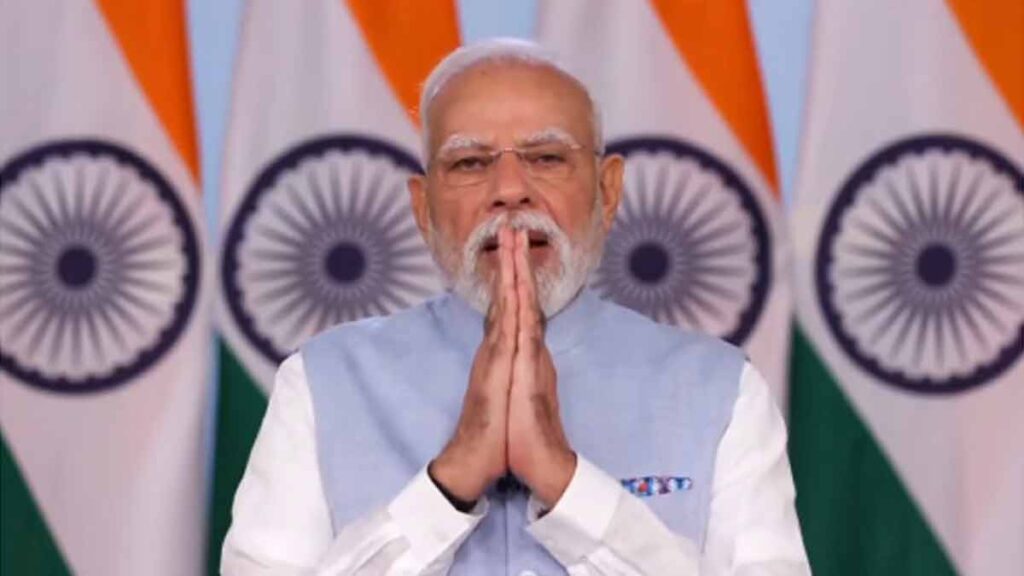
At the G20 Leaders’ Summit in Johannesburg, Prime Minister Narendra Modi unveiled a six-point global agenda aimed at addressing some of the world’s most persistent challenges. Rooted in India’s civilisational philosophy of shared growth and collective welfare, the proposals focus on knowledge sharing, capacity building, sustainable development and global security.
Key Initiatives Announced
Modi outlined six major initiatives that India believes can drive long-term, inclusive global progress.
The first proposal is the creation of a Global Traditional Knowledge Repository, which would document and share ancient wisdom related to sustainable living, wellness and community-centred development.
A second initiative, the Africa Skills Multiplier Mission, aims to train one million certified trainers in Africa over the next decade, equipping them to upskill millions of young people in their home countries.
The Prime Minister also called for the formation of a Global Healthcare Response Team — a rapid-response coalition of medical experts from G20 nations to assist countries during pandemics, natural disasters or sudden health emergencies.
Another key proposal focuses on dismantling the drug–terror nexus. Modi urged coordinated global action involving governance, financial tracking and security cooperation to counter the intersection of narcotics trade and terrorism.
India further proposed an Open Satellite Data Partnership, through which G20 space agencies would share satellite data to support developing countries in agriculture, fisheries, environmental monitoring and disaster management.
The final initiative, the Critical Minerals Circularity Programme, encourages recycling, second-life battery usage and urban mining to ensure stable, sustainable and environmentally responsible mineral supply chains.
Why the Proposals Matter
The initiatives reflect a shift in India’s global posture—from participant to proactive contributor—positioning the country as a development partner that shares knowledge, technology and capacity rather than merely financial resources. The proposals touch on essential sectors: public health, security, environment, youth empowerment and global resources.
By anchoring the agenda in values long associated with India—cooperation, sustainability and collective well-being—Modi framed India’s leadership role as both moral and strategic, especially at a time when global institutions face increasing strain.
Challenges and the Road Ahead
While the proposals were welcomed at the summit, their success will depend on sustained multilateral cooperation, funding commitments and long-term implementation mechanisms. Several initiatives, especially those involving satellite data sharing and critical mineral recycling, require technological alignment and policy coordination among diverse economies.
As the summit progresses, further clarity is expected on timelines, partnerships and execution pathways. For India, the agenda marks another step in projecting its soft power and its aspiration to shape global governance frameworks in the coming decade.