
Shrayan Sen
The strong tremors that shook Kolkata on friday were brief but revealing. Triggered by a magnitude 5.7 magnitude (though USGS reported it as 5.5 magnitude one) earthquake centred near Narsingdi in Bangladesh, the event reminded the city that seismic risk is not limited to the Himalayan belt. Kolkata reported no casualties or structural damage, yet the intensity with which the tremor was felt underscored an important truth: distance from Himalayan fault lines does not mean no risk.
This quake, though moderate and external, exposed a deeper set of concerns involving geology, urban vulnerability, ageing structures and preparedness.
The Event: A Quick Recap
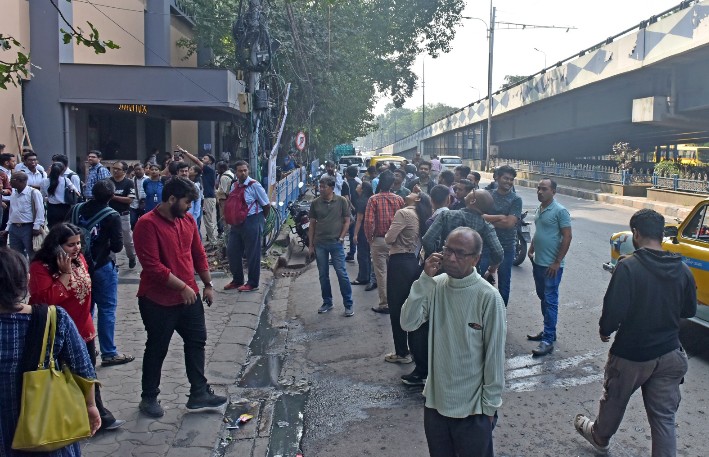
Ten minutes past 10 am on friday, shallow quake at a depth of roughly 10 km sent waves of shaking across Kolkata. Residents felt a sharp jolt that caused fans to sway and furniture to vibrate momentarily. Offices in Salt Lake, Park Street and New Town evacuated as a precaution, and thousands of people poured onto the streets.
Though the shaking lasted only seconds, its clarity and sharpness left a strong impression on the city.
Geological Perspective: Why Kolkata Felt It So Strongly
Kolkata’s seismic sensitivity stems from its position on the Bengal Basin, a vast alluvial plain composed of soft soil and deep sedimentary layers. These layers amplify seismic waves far more than rock-based terrain.
Another significant factor is the Eocene Hinge Zone, a major geological feature that passes beneath parts of West Bengal and Bangladesh. This structural boundary, formed by the folding and movement of ancient sediment layers, tends to respond sharply to seismic disturbances from neighbouring regions.
Because of these geological characteristics, even moderate earthquakes originating in Bangladesh or Northeast India can produce noticeable shaking in Kolkata, despite the city’s distance from major active faults.
Structural and Urban Vulnerabilities
Although the November tremor caused no visible damage, it highlighted several vulnerabilities:
• Ageing buildings: Kolkata is home to thousands of colonial-era and early-20th-century structures that lack seismic reinforcement.
• Population density: Sudden evacuations can create dangerous crowding in older neighbourhoods with narrow lanes.
• Mixed construction standards: Many mid-rise and informal structures have not been built with modern earthquake-resistant designs.
• Soil amplification: Soft alluvial soil magnifies shaking, especially in central and northern parts of the city.
• Potential for structural failures: Poorly maintained buildings with weak foundations or irregular load distribution may be at higher risk during stronger quakes.
These factors collectively place parts of Kolkata at risk even from moderate regional earthquakes.
Human Response: Panic Without Preparedness
The city’s reaction reflected limited familiarity with proper earthquake safety behaviour. Many people ran outdoors immediately, crowding into open spaces. While instinctive, such reactions are not always the safest, especially when falling debris, electrical hazards or traffic risks are present.
Recommended actions such as “drop, cover and hold on” were rarely observed. This lack of awareness points to a need for broader public education and regular drills in workplaces, residential complexes and schools.
Impact Across the Border
In Bangladesh, closer to the epicentre, the quake caused structural damage, injuries and reported fatalities. Buildings developed cracks, rooftops were damaged, and emergency authorities were deployed across several districts. The contrast in impact between Bangladesh and Kolkata illustrates how differences in distance, construction quality and geology significantly affect outcomes during seismic events.
Photo: Rajib Basu
Broader Implications for the Region
The November 21 tremor fits into a larger pattern of seismic events affecting eastern India and Bangladesh. While not classified as a high-seismic zone like the Himalayan foothills, the Bengal Basin remains susceptible to moderate-to-strong earthquakes due to underlying tectonic stress.
The event reinforces a key point: Kolkata is not seismically immune simply because it lies away from major fault lines. Geological amplification and urban density make the city vulnerable in unique ways.
What Kolkata Needs to Do
The tremor offers several lessons for long-term urban safety:
- Structural audits of older buildings, particularly in north and central Kolkata.
- Public awareness programmes on proper earthquake response.
- Routine earthquake drills in schools, offices and high-rises.
- Upgraded building codes and stricter compliance for new constructions.
- Urban planning reforms focusing on vulnerable zones with old infrastructure.
- Improved emergency communication systems to reduce panic and misinformation.
Conclusion
The 21 November earthquake was not a damaging event for Kolkata, but it was a significant one. Its sharp tremors served as a clear reminder that the city sits within a region capable of transmitting seismic energy over long distances. With its ageing building stock, dense population and amplifying geology, Kolkata cannot afford to treat earthquakes as distant Himalayan phenomena.
This tremor was gentle in effect but strong in message—a reminder to strengthen preparedness before a more serious seismic test emerges.