
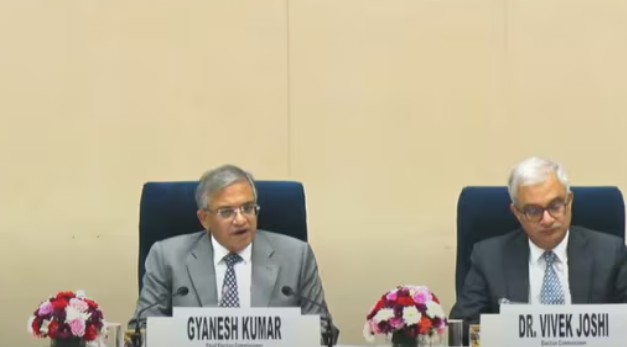
The Election Commission of India on Monday announced the schedule for the Bihar Assembly elections, setting the stage for a high-stakes political battle in the state. Polling will take place in two phases — on November 6 and November 11 — with counting of votes scheduled for November 14.
Out of the 243 assembly constituencies, 121 seats will go to polls in the first phase, while the remaining constituencies will vote in the second. The dates have been chosen to avoid overlap with the festive period of Diwali and Chhath Puja, both of which fall between October 18 and 28 this year. Election officials said the timing is aimed at ensuring greater voter turnout and smoother logistical management.
Major Political Contenders
The election is expected to see a fierce contest between the ruling BJP–JD(U) alliance and the opposition Mahagathbandhan, led by the RJD and Congress. Political strategist Prashant Kishor will also make his debut in electoral politics, with his outfit Jan Suraaj announcing plans to contest all 243 seats independently.
Chief Minister Nitish Kumar, a veteran in Bihar’s political landscape, remains a key figure in the contest. Having switched alliances multiple times in recent years, his leadership and the performance of the NDA coalition will be under intense scrutiny.
Voter List Revision Controversy
The run-up to the election has been marked by controversy surrounding the Special Intensive Revision (SIR) of the voter list. The Election Commission’s revision exercise reduced the total number of registered voters from nearly 7.9 crore to just under 7.24 crore. Opposition parties have alleged that the process may have disenfranchised sections of marginalized voters, while the EC maintains that the revision was carried out to eliminate duplicates and outdated entries.
The issue also reached the Supreme Court, which observed that the revision process could face judicial review if any illegality is established. The EC, however, has assured that all due procedures were followed.
The Political Context
In the 2020 Assembly elections, the BJP-led National Democratic Alliance (NDA) narrowly retained power, winning 125 seats, while the opposition bloc managed 110. Since then, Bihar has witnessed shifting alliances and renewed political equations, with Nitish Kumar’s moves often altering the balance of power in the state.
Political observers see this election as more than a state contest — it is being viewed as the first major test in the run-up to a series of assembly elections across West Bengal, Assam, Uttar Pradesh, and Punjab, which will eventually shape the political landscape ahead of the 2029 general elections.
As Bihar prepares for yet another decisive mandate, all eyes will be on how its voters respond to the shifting alliances, new entrants, and promises of change in one of India’s most politically dynamic states.