
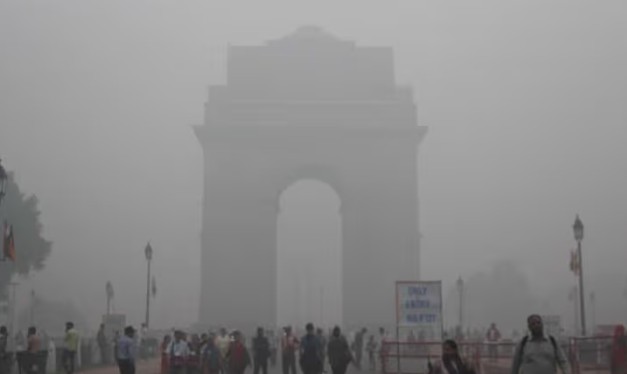
New Delhi woke up to another morning of hazardous air pollution as a thick layer of smog engulfed the city, pushing air quality into the ‘severe’ category. The Air Quality Index (AQI) remained alarmingly high across all monitoring stations, raising serious health concerns and disrupting daily life.
According to official data, the overall AQI hovered above 450 in the early hours, a level considered extremely harmful even for healthy individuals. Several residential and traffic-heavy zones reported AQI readings close to the upper limit of the scale, reflecting uniformly toxic conditions across the capital.
Visibility Drops, Impact Felt at Delhi Airport
The dense smog significantly reduced visibility across Delhi, particularly during the early morning hours. Low visibility conditions were reported in and around the Indira Gandhi International Airport, prompting authorities to issue advisories to passengers.
Airport officials stated that flight operations were continuing under low-visibility procedures. Passengers were advised to check flight status with airlines, as delays could not be ruled out due to fluctuating weather and air quality conditions.
Pollution Hotspots Record Critical Readings
Areas such as Rohini, Jahangirpuri, Vivek Vihar, Patparganj and parts of East and North Delhi recorded AQI levels nearing the severe-plus range. Pollution monitoring stations across the city consistently showed readings in the red zone, indicating dangerous concentrations of particulate matter, particularly PM2.5.
Experts attribute the spike in pollution to a combination of factors, including calm wind conditions, low temperatures, vehicular emissions, construction dust and residual effects of crop residue burning in neighbouring states.
Emergency Measures Under GRAP Intensified
In response to the deteriorating air quality, the Commission for Air Quality Management (CAQM) intensified restrictions under the Graded Response Action Plan (GRAP). Measures include stricter curbs on construction and demolition activities, restrictions on diesel vehicles, and enhanced monitoring of industrial emissions.
Authorities have also stepped up enforcement against pollution-related violations and urged government departments to ensure full compliance with emergency measures.
Health Advisory for Residents
Doctors and health experts have warned that prolonged exposure to such high pollution levels can cause severe respiratory distress, eye irritation, fatigue and cardiovascular complications. Vulnerable groups, including children, the elderly and those with existing lung or heart conditions, are at heightened risk.
Residents have been advised to avoid outdoor activities, keep windows closed, use air purifiers where possible and wear protective masks when stepping outside.
No Immediate Relief in Sight
Weather experts indicated that there is no immediate relief expected, as calm atmospheric conditions are likely to persist. Any significant improvement in air quality would depend on stronger winds or rainfall, which are not forecast in the near term.
As winter deepens, Delhi continues to battle its annual air pollution crisis, with authorities and citizens once again facing the challenge of coping with toxic air conditions.