
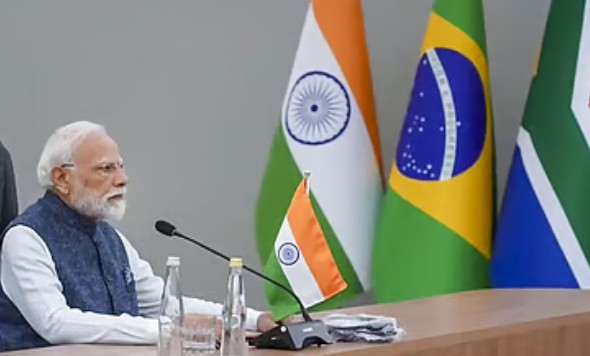
Prime Minister Narendra Modi on Sunday called for a global framework on talent mobility and proposed an international compact on artificial intelligence (AI) at the G20 Summit in Johannesburg.
Addressing the summit’s concluding session — which saw a boycott by the United States — Modi said the AI compact must ensure human oversight and enforce strict bans on the use of AI for deepfakes, crime and terrorism. AI systems affecting human life, security or public trust must be “responsible and auditable,” he said.
Modi cautioned that rapid technological advances were concentrating resources and opportunities in a few hands, which he described as a barrier to innovation. He stressed the need for human-centric technology, open-source models, and global cooperation. “Development must be sustainable. Trade should be trusted. Finance must be fair,” he added.
During the two-day summit, the Prime Minister highlighted the importance of inclusive access to technology and critical minerals. On Saturday, he proposed a “G20 critical minerals circularity initiative” to promote recycling, urban mining and second-life batteries, amid supply concerns linked to China.
Despite US objections, G20 leaders adopted a declaration addressing climate change and global challenges. South African President Cyril Ramaphosa said the declaration reflected renewed commitment to multilateralism. Brazil’s President Luiz Inácio Lula da Silva also said recent global forums indicated that multilateralism “is alive”.
The United States later accused South Africa of using its G20 presidency to undermine the group’s principles. Argentina, led by President Javier Milei, withdrew from negotiations shortly before the final text was adopted. The climate focus in the declaration was widely seen as a snub to US President Donald Trump, who has expressed scepticism on the issue.
At the IBSA meeting, Modi noted that India, Brazil and South Africa are still not represented on the UN Security Council and called UNSC reform a “necessity”. He proposed regular IBSA National Security Adviser-level meetings, a digital innovation alliance and a fund for climate-resilient agriculture.
Modi also suggested creating a G20 Open Satellite Data Partnership to make space data more accessible to developing countries. He announced that India would host the AI Impact Summit in February, emphasising that while AI may augment human abilities, human beings must remain responsible for final decisions.
India, Australia and Canada also launched a trilateral partnership on critical and emerging technologies, focusing on green-energy innovation and resilient supply chains.
In earlier sessions, Modi proposed a G20 initiative against the drug-terror nexus and a global health response team. He also introduced the G20-Africa Skills Multiplier, aiming to train one million certified trainers in Africa over the next decade.
During bilateral talks, Ramaphosa light-heartedly remarked on the challenges of hosting the G20, saying he might have avoided it had he known the difficulty. Modi responded: “Small is always beautiful.”