
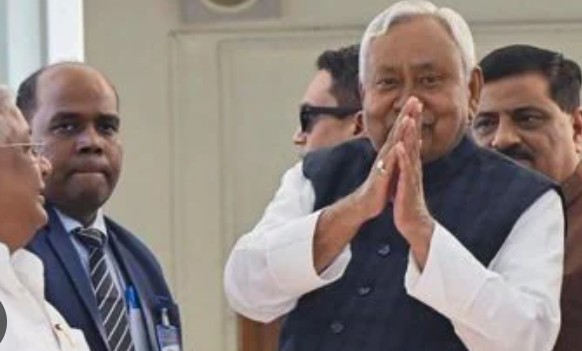
Chief Minister Nitish Kumar has handed over the crucial Home Ministry to the Bharatiya Janata Party (BJP), marking one of the most significant administrative shifts in Bihar in recent years. The decision comes immediately after Kumar assumed office for a record tenth term, despite his party’s strong electoral performance.
A Portfolio Nitish Held for Nearly Two Decades
Nitish has traditionally kept the Home portfolio with himself ever since he first became Chief Minister in 2005, barring a brief period between 2014 and 2015. The department oversees law and order, policing, internal security, and crime management — making it the single most powerful ministry in a state government.
By relinquishing this, Kumar has effectively redrawn the internal power structure of his new coalition government.
A Clear Assertion of BJP’s Growing Influence
The BJP, now the stronger partner in the ruling alliance, takes charge of the Home Ministry as part of the new arrangement. The shift underscores a recalibrated power balance within the coalition, where the BJP holds more key ministries despite JD(U) securing a large number of seats in the recent election.
The reassignment is being seen as a strategic expression of trust — and also a sign of the BJP’s expanding administrative footprint in the state.
Signals of Political Transition
Political observers suggest that the move may reflect the beginning of a longer-term transition in Bihar’s leadership structure. At 74, Nitish Kumar may be preparing for a more supervisory role, focusing on governance, coordination, and policy rather than the intense day-to-day oversight demanded by the Home portfolio.
Surrendering such an important department is widely viewed as an indicator that Nitish is ready to shift from hands-on administration to broader political management.
Implications for Governance and Law & Order
The change at the top of the Home Ministry is expected to influence policing priorities, internal security responses, and administrative practices across Bihar.
The new Home Minister from BJP will have the responsibility to shape law-and-order policy, appoint key officers, and possibly redesign the narrative around crime control — a recurring political debate in Bihar.
Early decisions, especially regarding police leadership and anti-crime measures, will be closely watched.
Alliance Dynamics in Focus
The handover is also a message from Kumar to the BJP, reinforcing coalition stability. However, it could also reshape internal dynamics, with JD(U) expected to retain strong departments like Finance to maintain its influence.
Whether this change strengthens the partnership or seeds future tensions will depend on how both parties navigate the early months of governance.
Public and Political Perception
Opposition parties are expected to examine this shift as a sign of JD(U) conceding space to its ally, while the ruling coalition may frame it as a redistribution of responsibility to improve efficiency.
The public response will largely hinge on whether law and order improves under the new leadership and whether the administrative reset translates into better ground-level governance.