
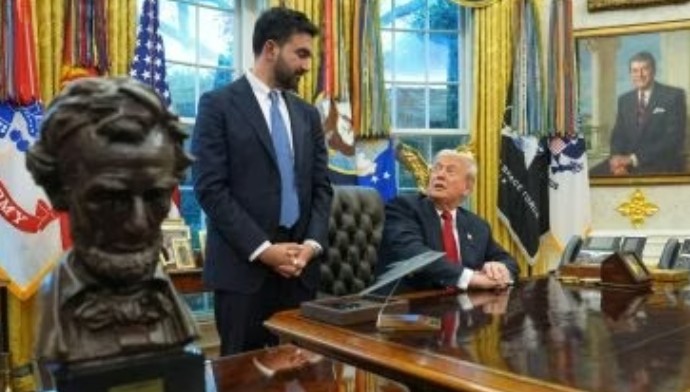
In a meeting that surprised many across political lines, New York City Mayor-elect Zohran Mamdani met former U.S. President Donald Trump at the White House on Friday, marking an unexpected moment of cordial exchange between two leaders who have long been at ideological odds.
The 34-year-old Mamdani, who takes office on January 1, will be the first Muslim and first South Asian mayor of New York City. Known for his progressive stance and sharp criticism of Trump’s past policies, the young Democrat’s meeting with the former Republican president came as a notable shift in tone.
A Calm Encounter in a Charged Political Climate
Inside the Oval Office, both leaders appeared to set aside partisan hostilities for a discussion focused on cooperation and common ground. Trump, who had previously referred to Mamdani as a “radical left lunatic,” struck a conciliatory note after the talks.
“We agreed on a lot more than I thought,” Trump said. “I don’t know exactly what he means by ‘turning the volume up,’ but he has to be careful when he says that to me. The better he does, the happier I am.”
Mamdani described the meeting as “productive,” stating that his administration would collaborate with the federal government wherever the interests of New Yorkers align. “We will work together where we can, and stand our ground where we must,” he said following the meeting.
Policy Focus: Shared Goals, Different Roads
Discussions reportedly covered issues including public safety, federal funding, and infrastructure development in New York City. Both leaders emphasized the need for a “strong and safe New York,” though their visions for achieving it remain sharply different.
Trump has in the past threatened to withhold federal funds from the city over disagreements on policing and immigration policies — a move Mamdani has publicly opposed. Despite that, Friday’s meeting hinted at a pragmatic willingness to engage.
Symbolism and Strategic Optics
Political observers viewed the meeting as more than a routine courtesy call. For Mamdani, it signaled a readiness to engage on a national stage and to bridge divides without compromising on principles. For Trump, it was an opportunity to project an image of statesmanship and flexibility, even toward one of his former critics.
“The meeting may not resolve deep ideological differences,” said one Washington analyst, “but it shows that dialogue is still possible in an increasingly polarized America.”
Looking Ahead
Mamdani will face immediate challenges upon taking office, including housing affordability, migrant policy management, and rising urban costs. Whether this initial outreach with Trump’s administration will lead to tangible cooperation remains uncertain.
Still, the quiet composure of Friday’s exchange stood out in a season of political turbulence. For once, the Oval Office offered a glimpse of civility — however brief — between two leaders representing very different visions of America’s future.