
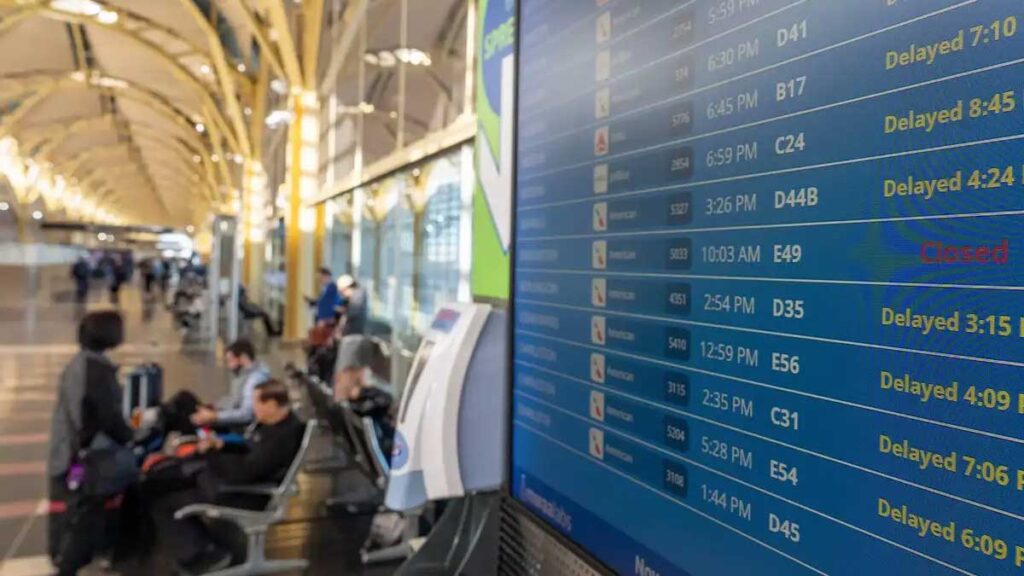
Airlines across the United States have begun cancelling flights amid the ongoing government shutdown — the longest in the country’s history — disrupting travel plans for thousands of passengers and straining the nation’s aviation system.
More than 700 flights scheduled for Friday have already been cancelled by the country’s four largest airlines, with further disruptions expected over the coming week. The crisis has deepened tensions between Republicans and Democrats as President Donald Trump pushes for a funding deal to end the impasse.
FAA orders flight capacity cuts
To address safety risks and staff shortages, the US Transportation Department and the Federal Aviation Administration (FAA) announced on Wednesday a phased reduction in flight capacity across 40 major airports. Transportation Secretary Sean Duffy and FAA Administrator Bryan Bedford said the move was necessary to “maintain safety and manage fatigue-related risks” in the system.
Starting Friday, airlines must reduce domestic flights by 4%, followed by 6% on Tuesday, 8% on Thursday, and 10% by the following Friday. The order applies to flights between 6 a.m. and 10 p.m. local time. Affected airports include New York’s LaGuardia, Newark, and JFK, as well as major hubs in Los Angeles, Chicago, Denver, and Atlanta.
Airlines react to emergency order
United Airlines announced it would implement a 4% cut this weekend — roughly 200 flights per day — and gradually increase reductions to 10% over the next week. Delta Air Lines cancelled about 170 Friday flights, American Airlines cut 220 per day through Monday, and Southwest removed 120 Friday flights.
The reductions affect domestic routes only. International services remain largely unchanged, though the FAA has also suspended commercial space launches during certain hours and may halt air traffic control operations in understaffed facilities.
Industry impact and political response
Analysts say the “big four” carriers — American, Delta, Southwest, and United — will feel the greatest impact through November and December, with an estimated 6% overall reduction in seating capacity. Despite this, airlines say most long-haul international routes will operate normally, and affected passengers will be contacted directly.
FAA officials warned that the move was prompted by increasing strain in the National Airspace System (NAS). Congressman Rick Larsen, the top Democrat on the House Transportation Committee, criticised the decision, demanding the FAA release its safety data and risk assessment.
The agency said safety reports from October revealed growing concerns about system reliability and evidence of “increased stress” at key airports.
Staff shortages strain air travel
Since the funding lapse began on October 1, staffing shortages among air traffic controllers have slowed operations nationwide. Over 13,000 controllers and thousands of TSA agents are currently working without pay, leading to more sick calls and widespread fatigue.
Transportation Secretary Duffy said staffing-related issues now account for a much higher percentage of delays than normal, as the shutdown drags on.
Chris Sununu, president and CEO of Airlines for America, said more than 3.4 million passengers have already been affected by cancellations and delays linked to the shutdown. He warned that disruptions could worsen as the busy Thanksgiving travel period approaches.