
Shrayan Sen
As seas rise and storms strengthen, a silent catastrophe is unfolding across the planet’s most vulnerable nations — exposing a profound injustice. Countries with the smallest role in global warming are now paying the greatest price for humanity’s fossil-fuel past.
These places are just mere dots on a map — they are homelands, ancient cultures, languages and memories. And yet today, many are being forced to contemplate something that should haunt the conscience of the world: what happens when a nation loses its land?
Pacific and Indian Ocean Nations Facing Erasure
Across the Pacific and Indian Oceans, nations such as Tuvalu, Kiribati, the Maldives, the Marshall Islands, Nauru, Vanuatu and the Solomon Islands stand on the frontlines of a crisis they did not create. Together, they contribute a fraction of a fraction of global emissions, far below 0.05 per cent of the world’s carbon output — yet they face the existential threat of complete submergence.
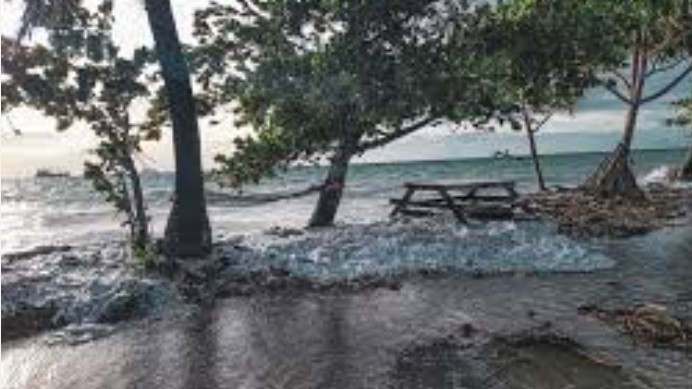
Already, homes in Tuvalu and Kiribati are inundated during annual king tides. Freshwater sources are contaminated by salt. Food crops fail. Cemeteries are swallowed by the sea. Communities are forced to choose between leaving behind ancestral land or accepting a life surrounded by encroaching water.
Tuvalu’s Prime Minister Kausea Natano warned the UN General Assembly:
“We are literally sinking. But we will not give up fighting to exist and to maintain our identity, culture and land.”
In the Maldives, where 80 per cent of land lies less than a metre above sea level, survival depends on engineering what nature can no longer protect. Former Maldives President Mohamed Nasheed once cautioned:
“If global warming is not checked, we will all become climate refugees. Our nation will become a museum.”
These warnings are no longer predictions — they are lived reality.
The Caribbean: Ground Zero for Supercharged Storms
The same injustice crashes furiously onto Caribbean shores — islands whose contributions to global warming are negligible, but whose suffering grows with each hurricane season.
When Hurricane Melissa struck Jamaica and Cuba this year, its power laid bare the new climate normal:
more water, stronger winds, slower weakening, and destruction that outpaces recovery. Homes were uprooted, townships flooded, critical infrastructure shattered — the trauma still fresh in the minds of those who endured the storm.
Jamaica’s Prime Minister Andrew Holness stated bluntly:
“We are facing storms made stronger by a problem we did not create. Jamaica has one of the smallest carbon footprints, yet we suffer some of the greatest damage.”
Across the region — Dominica, St. Vincent and the Grenadines, Haiti, Puerto Rico — the memories of Maria, Irma, Ivan and now Melissa still linger in broken communities. “Once in a century” storms return every few years.
Who Really Caused This Crisis?
The truth sits heavy and undeniable.
The world’s top four emitters — China, the United States, India and the European Union — are responsible for nearly 60 per cent of global emissions. Meanwhile, these vulnerable nations barely register on any emissions chart.
As Marshall Islands Climate Envoy Kathy Jetñil-Kijiner told global leaders:
“We are not drowning. We are fighting. But we need you to fight with us.”
Yet support arrives in promises, not in protection.
Diplomacy Becomes a Battle for Existence
For frontline nations, climate negotiations are not about distant targets — they are about survival. They are demanding:
• A fully funded international Loss and Damage mechanism
• Legal recognition and protection for climate-displaced people
• Assurances that sovereignty will remain intact even if territory disappears
The world must now answer questions without historical precedent:
If a country loses its land to the sea, do its people lose their nationality?
Does its flag cease to fly?
The implications are staggering, and time is thinning.