
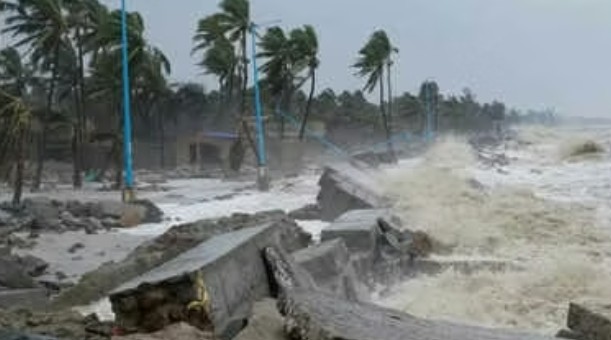
A deep depression over the central Bay of Bengal is set to intensify into a cyclonic storm named Montha — a name contributed by Thailand. According to the India Meteorological Department (IMD), Montha is likely to make landfall near Kakinada, within a stretch of about 100 km north and south, on October 28.
At the time of landfall, wind speeds may reach 90 to 100 kmph, gusting up to 110 kmph, accompanied by torrential rain and high sea waves along the Andhra Pradesh coast.
Partial impact on neighbouring states
The cyclone will have a partial impact over north Tamil Nadu and south Odisha, bringing widespread rainfall and strong gusty winds across the coastal belt. Preparations are already underway in vulnerable districts as sea conditions turn rough.
Expected impact in West Bengal
Although West Bengal will not face a direct cyclone strike, the state will experience significant rainfall due to the cyclone’s outer spiral bands spreading north and northwestward. From Tuesday (October 28) onwards, rains are expected across the southern districts, followed by widespread moderate to heavy rainfall as the system progresses inland.
As Montha moves through Odisha, Jharkhand, and Bihar, it will weaken into a depression and later into a low-pressure system. Despite the weakening, it will continue to generate moderate to heavy rain over most parts of West Bengal, including western and northern districts.
The period between October 28 and 31 will see intermittent showers, with heavier spells likely over Bankura, Purulia, Paschim Medinipur, Birbhum, Jalpaiguri, and Alipurduar. Kolkata and adjoining areas may witness occasional rain and cloudy skies during this time.
Fishermen and agricultural advisories
A total ban on fishing in the Bay of Bengal has been announced from October 27 onwards, as sea conditions will remain very rough to high.
Farmers have been urged to harvest standing crops immediately and move produce to shaded or protected areas, since prolonged rain may cause damage to paddy fields and stored grains.
Preparedness and monitoring
Disaster management teams in Andhra Pradesh, Odisha, and Tamil Nadu have been placed on high alert. Meanwhile, West Bengal authorities are monitoring the evolving system closely to issue localized warnings as rainfall intensifies. Residents in low-lying and flood-prone areas have been advised to remain alert and follow official weather updates regularly.