
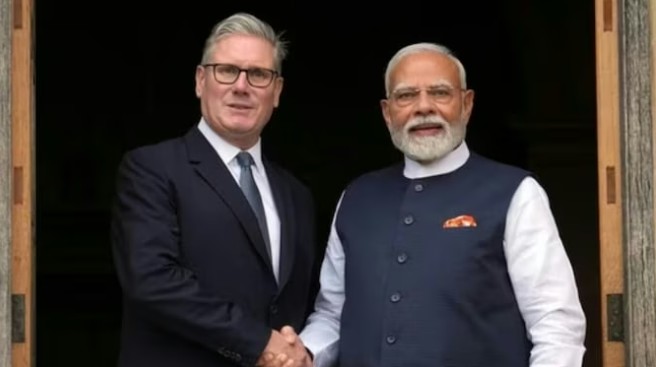
British Prime Minister Keir Starmer is set to visit India next week. On his two-day trip, Starmer will arrive in New Delhi on Wednesday, October 8. This will be his first visit to India since becoming Prime Minister of the United Kingdom. While India’s trade agreement with the United States remains stalled amid diplomatic tensions with the Trump administration, a Free Trade Agreement (FTA) was recently signed between India and the UK. Against this backdrop, Starmer’s visit to India carries significant importance.
According to a statement issued by India’s Ministry of External Affairs on Saturday, Starmer will meet Prime Minister Narendra Modi in Mumbai on Thursday. Details of the meeting’s agenda have not been disclosed, but the ministry has indicated that discussions will cover a wide range of topics — including trade, investment, technology, innovation, defence, climate, energy, health, education, and strengthening people-to-people ties between the two nations. Strategic partnership issues as well as regional and global matters are also expected to be part of the talks.
Following the bilateral meeting, Starmer is scheduled to participate in a roundtable discussion with Prime Minister Modi in Mumbai, where he may interact with experts and entrepreneurs from various industries. Notably, India and the UK signed their Free Trade Agreement this past July. It is expected that the two leaders will also discuss the FTA during Starmer’s visit.
The agreement was jointly announced by Modi and Starmer at a press conference in London on July 24. Once the deal comes into effect, medical and aviation equipment made in or imported from the UK will become cheaper for Indian citizens and companies. Similarly, products such as soft drinks, chocolates, cosmetics, biscuits, cars, lamb, and salmon from the UK will become more affordable in India. Previously, these items were subject to an average tariff of 15%, which will now be reduced to 3% under the FTA. Tariffs on electric vehicles will drop dramatically — from 110% to 10%.
India’s trade policy has been clear from the beginning: the country will trade with whichever nation offers the greatest benefits, provided there are no international sanctions. U.S. President Donald Trump has expressed disapproval of India’s business relations with Russia and has imposed steep tariffs on Indian goods as a result. Bilateral trade talks between India and the U.S. had been stalled for a long time, though discussions have recently resumed. No breakthrough has been announced yet.
Amid this uncertain U.S.–India trade scenario, the British Prime Minister’s upcoming visit has generated considerable public interest